
What is HTMA and how can it help me?
If you prefer to listen than read, you can hear the audio of this blog post, read by the author, Vanessa Obagi, below
If you’ve heard me talking about HTMA (Hair Tissue Mineral Analysis), mineral balancing, and the difference it can make to how you feel, you may have wondered:
“But what actually is HTMA, and what could it tell me about my health?”
Especially if you don’t think of yourself as someone with a “mineral problem”, because, let’s face it, who does?
Perhaps you’re running on empty, struggling with stubborn weight gain, waking up tired after another broken night’s sleep, or finding that brain fog, anxiety, ADHD, digestive issues, headaches, aches and pains, or changes in your skin and hair have become part of everyday life. Maybe perimenopause or menopause has brought a whole new collection of symptoms into the mix, too.
On the surface, these things can seem completely unrelated. So why would I suggest looking at your minerals?
Because minerals are involved in almost everything your body does (and this is no exaggeration).
They help your body produce energy, respond to stress, regulate blood sugar, support thyroid activity, send nerve signals, produce brain chemicals, and much more. So when your mineral picture is out of balance, the effects can show up in all sorts of ways you might never think to connect.
That’s why HTMA can be such a useful place to start.
In this post, I’m going to explain exactly what HTMA is, what your results can (and can’t) tell us, and how a small sample of hair can give us useful clues about what may be going on underneath your symptoms - and what we can do about it.
First, what exactly is HTMA?
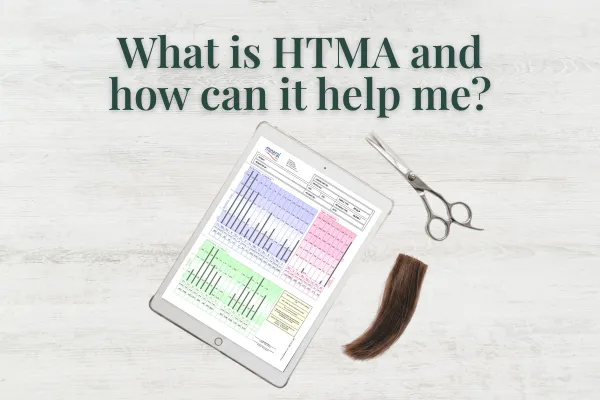
It’s a laboratory test that measures levels of various minerals and certain toxic elements in a small sample of your hair and I use it in all of my programmes, and with every single client I help.
But before we get into how testing your hair works, it’s important to understand why I’m interested in your minerals in the first place.
Because minerals aren’t just nutrients you occasionally hear about when someone tells you to take magnesium for sleep or zinc for your immune system.
Your body simply can’t work properly without them.
Your body can’t make minerals on its own, so you have to get them from food, water and, when needed, supplements. They’re not just ‘nice to have’ - they’re essential.
This is why I often think of minerals as part of the body's operating system.
Hormones, enzymes and individual body systems tend to get far more attention. But minerals help many of those processes happen in the first place.
And that’s where HTMA becomes useful.
Your symptoms are clues, but they aren't the whole story
When you come to me feeling exhausted, flat, unable to concentrate or as though you’ve simply lost your get-up-and-go, those symptoms matter.
They’re clues. But the symptom itself doesn’t always tell us why it’s happening.
Take fatigue, for example. There isn’t one single reason why someone feels tired. Two women could come to me and describe almost identical symptoms.
Both could say:
“I’m exhausted all the time.”
“I’m waking up tired.”
“I can't cope with stress like I used to.”
“My brain feels foggy.”
“I just don't feel like me anymore.”
On the surface, they seem to have the same problem, so you might expect their mineral results to look similar. But they could actually be very different.
That means giving both women the same supplements or nutrition advice based on guesswork may be a pretty bad idea.
I want to understand what is contributing to your symptoms, (ather than guessing based on the symptoms alone). HTMA gives me a crucial piece of that puzzle.
HTMA isn't simply a test for mineral deficiencies
HTMA isn't simply a test for mineral deficienciesThis is one of the biggest misconceptions about mineral testing.
You might assume we’re testing your hair to discover whether you’re deficient in magnesium, zinc or another mineral, and then simply replacing whatever appears to be low.
But mineral balance is far more complex than that.
With HTMA, I am of course interested in the individual mineral levels, but I’m just as interested in how those minerals relate to one another.
That’s because minerals don’t work in isolation. The level of one mineral can affect how another behaves or is used by your body.
So when I work with clients, I don’t look at one mineral on its own. I look at the whole pattern - what’s high, what’s low and, importantly, how the minerals are balanced against each other.
That wider picture can help us make more sense of symptoms like exhaustion, feeling wired but tired, blood-sugar crashes or simply not feeling like yourself.
The test can also measure certain toxic elements, such as aluminium, mercury and arsenic, which gives us another useful piece of information to consider.
But importantly, I’m not using HTMA to diagnose a disease or condition.
I’m using the patterns to help build a clearer picture of what may be going on for you.
Think of HTMA as looking under the bonnet
Imagine you're driving your car and a warning light appears on the dashboard. You know something needs attention, but you don’t yet know what’s happening underneath the bonnet.
Your symptoms can be a bit like that.
Fatigue is a warning light. Brain fog is another. So are the other nagging symptoms that tell you something just isn’t quite right.
The temptation is to chase each warning light individually.
You're tired, so take an energy supplement or drink coffee.
You can't sleep, so take something for sleep.
You're stressed, so take something for stress.
But I’m much more interested in asking:
What is it that is contributing to these symptoms in the first place?
HTMA is one of the ways I can look under the bonnet and gather more information and it can help us build a much more useful picture than simply chasing each symptom separately.
From a teaspoon of hair to a much bigger picture
So what actually happens when you have an HTMA?
It’s surprisingly straightforward.
We take a small sample of hair, which is sent to a specialist laboratory.
As your hair grows, minerals and certain toxic elements become deposited in it. The laboratory can then measure them.
I then analyse those results.
But I don't just look down the report and think: “Low magnesium. Take magnesium.”
Then I combine those results with you - your symptoms, health history, diet and lifestyle, what’s been happening in your life and what you’re struggling with now.
My job is to put those pieces together so we can work out what you need and build a plan around it.
Why you shouldn't simply take a load of minerals
At this point you might be thinking:
“If minerals are so important, shouldn't I just take more of them, or perhaps get a multi-vitamin/mineral supplement?
The answer is no. When it comes to minerals, more is not always better.
Taking a load of supplements without knowing what you actually need can sometimes do more harm than good. That’s why I don’t recommend throwing supplements at your symptoms and hoping something works, or simply taking a pre-formulated multi.
What you need may be very different from what your friend, sister or colleague needs - even if you're experiencing similar symptoms.
The aim isn't to cram as many minerals into your body as possible.
It’s about understanding your mineral picture first, so we can work out what you actually need.
But surely I should be getting all the minerals I need from food?
Yes, food absolutely should be our main source of minerals, and good nutrition is always an important part of the work I do.
But there’s a catch. The minerals in our food start with the soil it’s grown in. Soil quality, modern farming and growing conditions can all affect how many minerals end up in our food. So even if you eat a really good diet, you may not always be getting as much of every mineral as you think.
And what you eat is only part of the story. Your body still has to absorb and use those minerals. Stress, medications, alcohol, digestive problems and even the stage of life you’re in can all affect how much you need and how well your body uses them.
That’s one of the reasons I use HTMA. It gives me a clearer idea of what you may need, so I can tailor your food and supplements to you.
What about vitamins - can HTMA tell me about those too?
HTMA is a mineral test, so it doesn’t measure your vitamin levels.
But that doesn’t mean vitamins are separate from the picture.
Vitamins and minerals work together in the body, and each can affect how well the other is used.
So I don’t look at your HTMA results in isolation and forget about everything else. I consider them alongside your symptoms, health history, diet, lifestyle and, where appropriate, other testing.
Stop chasing symptoms and start asking what’s causing them
This is really the reason I use HTMA.
Chasing symptoms doesn't fix things long term. I want to investigate, and I want to understand your individual situation.
And I want any nutrition, lifestyle or supplement recommendations I make to have a clear reason behind them.
The aim is to understand what your body may need, rather than simply reacting to each new symptom as it appears.
Want to find out what your minerals could be telling you?
If you’re curious about your mineral picture and want clear, personalised answers rather than more guesswork, Mineral Health Decode is the place to start.
Mineral Health Decode includes your HTMA test, my full analysis of your results, and a personalised food, lifestyle and supplement plan based on what we find.
You won’t be left with a complicated lab report and expected to work it all out yourself. I’ll explain what your results mean for you, what stands out and, most importantly, what to do next.
Once you have your results, if you'd like further support, you can book a results and strategy call with me, or move on to a programme with more support.
But if fatigue is your biggest issue, and you already know you want more hands-on help, The Fatigue Fix is the absolute best place to start. It includes HTMA testing as part of a fully personalised four-month programme for those with persistent tiredness or chronic fatigue, brain fog or that frustrating feeling that you’ve lost your get-up-and-go.
Not sure which option is right for you? Send me a message, and I’ll help you decide where to start.


